Gas vs Electric Warm Air Heaters: Which Is Best for Your Commercial Building?
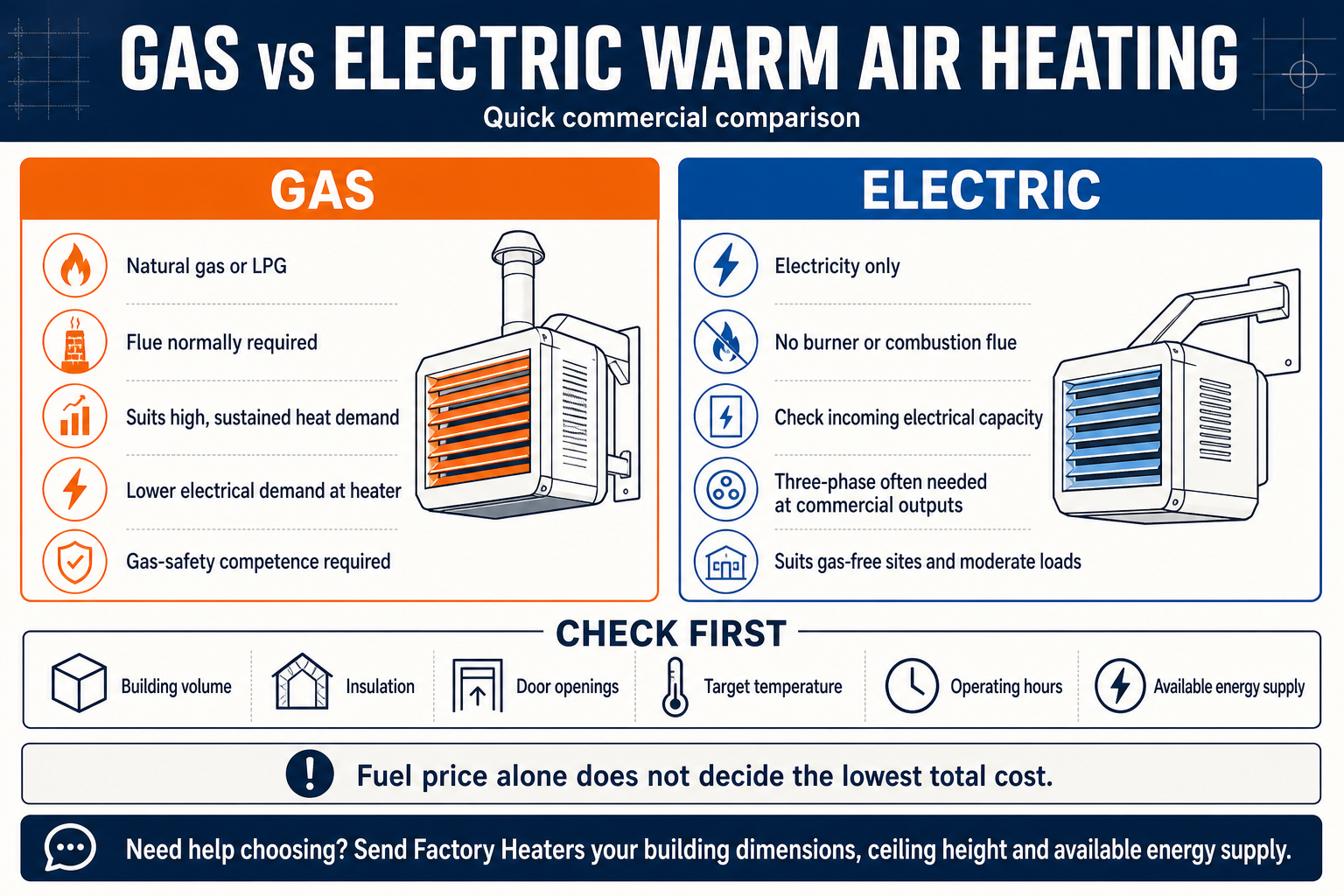
Gas warm air heaters are often the more practical choice for large buildings that require substantial heat for long operating periods and already have a suitable gas supply. Electric warm air heaters become attractive where gas is unavailable, avoiding combustion and a flue is valuable, or the building has sufficient electrical capacity.
That is only a starting point. The right choice also depends on the building’s heat loss, operating hours, electrical infrastructure, ventilation, door use and longer-term energy plans. A lower-cost heater can become an expensive decision if its energy source or output does not suit the building.
Gas vs electric warm air heaters at a glance
| Consideration | Gas warm air heater | Electric warm air heater |
|---|---|---|
| Energy source | Natural gas or LPG, plus electricity for fans and controls | Electricity |
| Heat generation | Burner heats a heat exchanger; a fan distributes warm air | Electric elements heat the air; a fan distributes it |
| Flue | Normally required for an indirect-fired commercial unit | Not required |
| Local combustion | Yes | No |
| Electrical demand | Relatively modest electrical supply for fans and controls | Can require substantial electrical capacity |
| Typical strength | Higher-output, frequently heated commercial or industrial spaces | Gas-free buildings, smaller loads, intermittent use or electrification projects |
| Running costs | Often favourable where gas is available, subject to tariff and efficiency | Usually more expensive per unit of input energy, but site tariffs vary |
| Installation | Gas supply, flue route, combustion air and competent gas work required | Suitable circuit, isolation, protection and possibly three-phase power required |
| Maintenance | Burner, heat exchanger, flue, fan and controls require attention | No burner or flue, but elements, fans, connections and controls still require inspection |
| Point-of-use emissions | Produces combustion gases, discharged through the flue | No combustion emissions at the heater |
Neither option is automatically best. Gas frequently has an operating-cost advantage for a large, continuously heated warehouse. Electric can make better commercial sense where installing gas and a flue would be costly, heating demand is limited, or the site has an appropriate electrical supply.
How does gas warm air heating work?
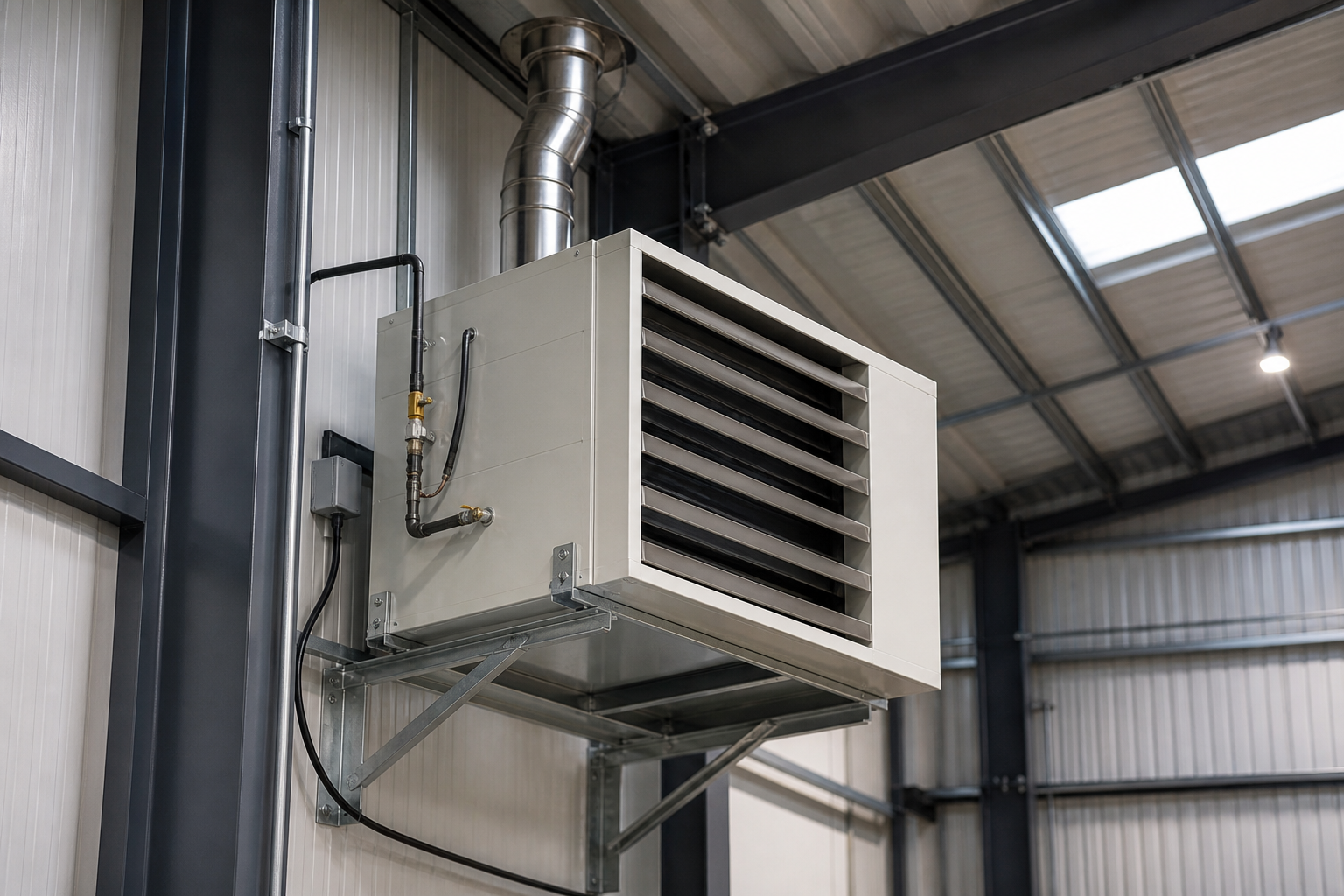
A gas-fired warm air heater burns natural gas or LPG. The burner heats a metal heat exchanger, while a fan draws building air across that exchanger and sends the warmed air into the occupied space.
In an indirect-fired unit, the building air remains separate from the products of combustion. Those gases leave through a correctly designed flue. The UK Government’s Energy Technology List explanation of warm air heating describes the distinction between direct and indirect-fired equipment.
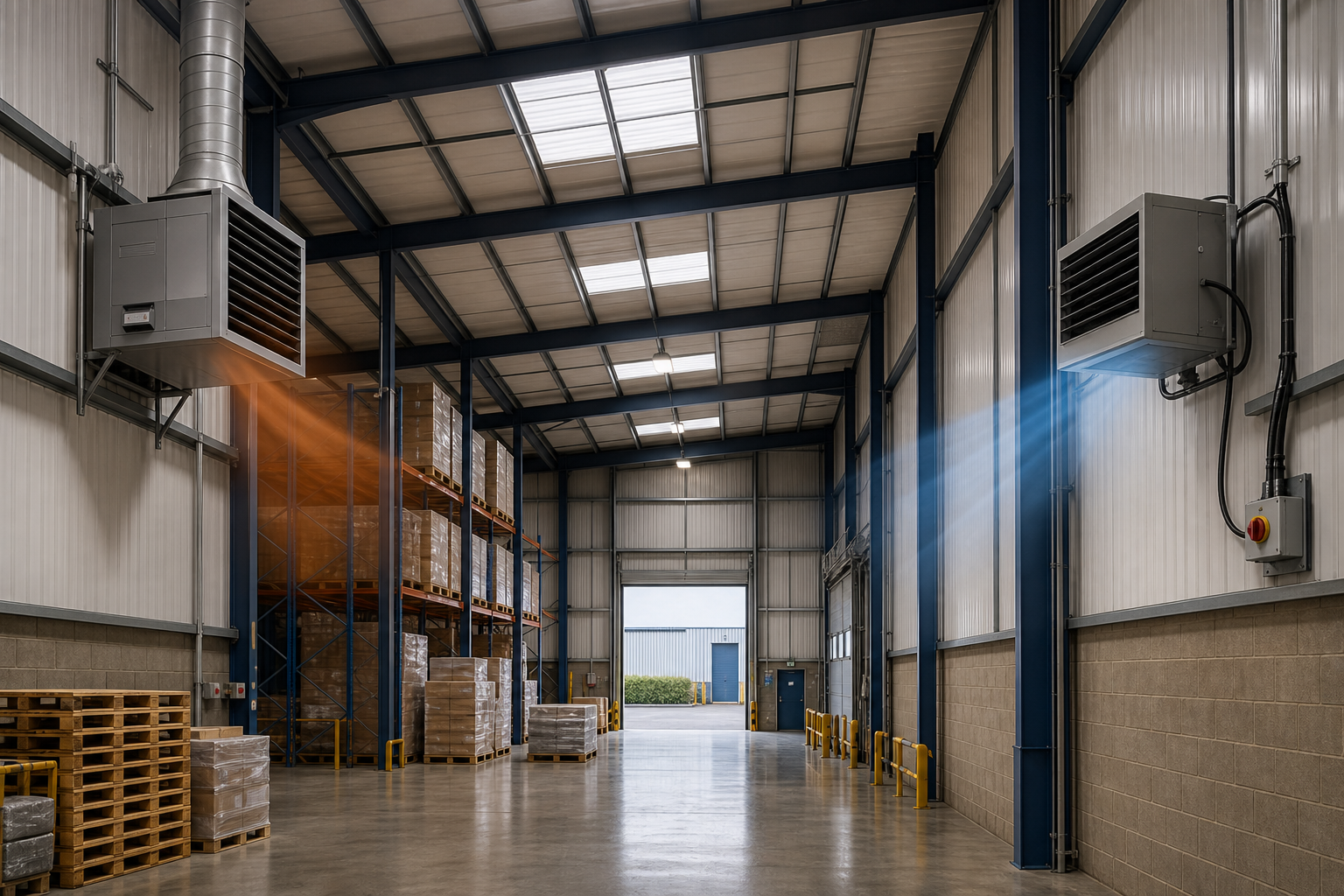
Commercial units are commonly mounted on a wall or suspended from the roof structure. Directional louvres help distribute air across warehouses, workshops and factory floors without occupying valuable working space.
Factory Heaters supplies natural-gas and LPG models within its range of gas warm air heaters. Current Winterwarm options include modulating and condensing models across several outputs.
How does electric warm air heating work?
An electric warm air heater passes current through resistance elements. A fan moves air over the elements and distributes it around the building.
There is no burner, gas connection or combustion flue at the heater. That can simplify the mechanical side of an installation, but it does not necessarily make the project plug-and-play. Commercial electric heaters can impose a substantial load on the building’s electrical system.
The Winterwarm EH range illustrates this clearly. Its published outputs extend from 5 kW to 59.4 kW. The manufacturer’s technical documentation specifies a 400 V three-phase and neutral supply for most of the range, although the smaller EH5 and EH10 models can also be configured for single-phase power. The required current rises sharply with heater output, so available capacity must be checked before a model is ordered.
You can compare the current electric warm air heater range, but the building’s electrical supply should be confirmed before treating electric heating as the simpler option.
Which costs less to run?
Gas is often cheaper for high and sustained heat demand because UK non-domestic electricity typically costs more per kWh than gas. The difference varies by consumption band, contract, location and billing structure, however, so domestic price-cap figures should not be used to estimate commercial heating costs.
The Department for Energy Security and Net Zero publishes updated non-domestic gas and electricity price data. Your own contracted rates are more useful for a purchasing decision.
A basic comparison should use:
Annual energy cost = energy input × operating hours × average load × unit price
For a gas heater, account for the appliance’s seasonal efficiency rather than comparing nominal output directly with fuel input. For an electric resistance heater, input and useful heat output are much closer at the point of use, but electricity may cost more per kWh.
The calculation should also include:
- Standing charges and capacity charges
- Gas or LPG infrastructure
- Flue and installation costs
- Electrical-distribution upgrades
- Controls and zoning
- Planned maintenance
- Expected operating life
- Likely operating hours
- Energy generated on site, where applicable
A heater used for two hours each morning presents a different case from one maintaining temperature across a two-shift warehouse.
When is gas warm air heating likely to be the better choice?
Gas deserves serious consideration where:
- The building already has a suitable natural-gas supply.
- A safe, compliant flue route is available.
- The space has a large design heat load.
- Heating is required for long periods.
- The existing electrical supply cannot support high-output resistance heating.
- The business wants natural gas or LPG options.
- Fast recovery is required after large doors have been opened.
Larger warehouses and factories can require several high-output units. In that situation, replacing the same useful heat output with direct electric heaters may require major electrical infrastructure work.
Gas should not be selected purely because the unit price of fuel is lower. A poorly sized or badly controlled heater will still waste energy, particularly in a tall building where heated air can collect near the roof.
When is electric warm air heating likely to be the better choice?
Electric can be a strong option where:
- No gas supply is available.
- Providing a flue is difficult or undesirable.
- The heat load is moderate.
- Heating is intermittent or confined to particular zones.
- The premises already has adequate three-phase capacity.
- Avoiding combustion at the heater is an operational priority.
- The building or landlord has a defined electrification policy.
- On-site generation forms part of the energy strategy.
Electric heating does not automatically produce low running costs or low whole-system emissions. Both depend on the electricity tariff, operating schedule and source of power.
For a compact, well-insulated workshop with limited heating hours, simpler mechanical installation may outweigh the higher price of electricity. For a large, poorly insulated warehouse operating throughout winter, the electrical demand can be much harder to justify.
Electrical capacity can decide the question
Facilities managers sometimes compare heater purchase prices before checking the incoming electrical supply. That reverses the correct order.
A 40 kW electric warm air heater is a major fixed load. The site must have adequate incoming capacity, distribution equipment, cable sizing, protection and isolation. Other equipment operating at the same time must also be considered.
The Winterwarm EH technical data specifies approximately 59 A per phase at full output for its 39.6 kW model. That figure is specific to the product and should not be treated as a universal sizing rule, but it shows why a supply assessment matters.
Where electrical upgrades are required, include them in the project cost before deciding that electric is easier to install.
Gas installation, flues and ventilation
A gas warm air heater needs more than a fuel connection. The installation must consider:
- The approved fuel and supply pressure
- Flue type, length and termination position
- Combustion-air requirements
- Clearances from combustible materials
- Suspension or mounting arrangements
- Access for inspection and servicing
- Condensate disposal for condensing models
- Control interlocks where required
The HSE tells employers to use an appropriately qualified Gas Safe registered engineer or competent person, depending on the premises and work involved. It also requires gas appliances, pipework and flues to be maintained and warns against obstructing ventilation openings or flues.
Product selection can be completed online, but the final gas installation should be assessed and undertaken by people qualified for the relevant commercial equipment.
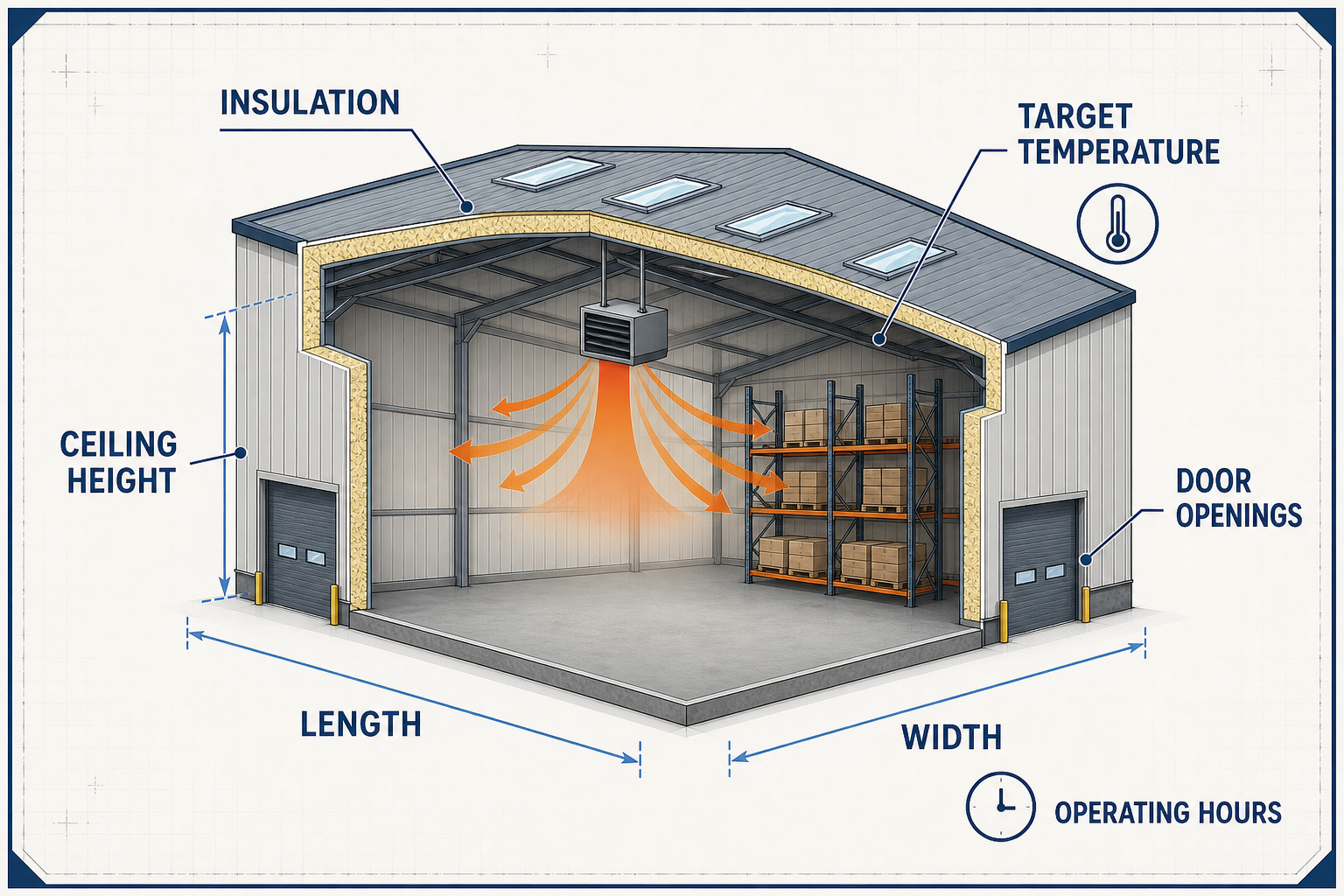
Size the building before choosing the fuel
Floor area alone does not provide enough information to size a commercial heater. A 500 m² workshop with a 3-metre ceiling is a different heating problem from a 500 m² warehouse that is 10 metres high.
A useful assessment should consider:
- Length, width and internal height
- Wall and roof construction
- Insulation condition
- Windows and rooflights
- Desired indoor temperature
- Local winter design temperature
- Roller-shutter and loading-bay use
- Mechanical extraction and air changes
- Occupancy and working patterns
- Heat produced by machinery
- Areas that do not require heating
- The position of racking, machinery and partitions
The HSE says indoor workplaces should normally be at least 16°C, or 13°C where work involves rigorous physical effort. It also stresses that thermal comfort depends on air movement, humidity, clothing and work rate, not air temperature alone. See the current HSE workplace-temperature guidance.
For initial product guidance, send Factory Heaters the building dimensions, ceiling height, available energy supplies and intended operating hours. Large or complicated buildings may need a formal heat-loss calculation and system design.
Do not overlook controls and air distribution
Controls can affect the outcome as much as the fuel choice. Look for a system that can match output to demand rather than repeatedly operating at full capacity.
Useful features may include:
- Modulating heat output
- Programmable operating periods
- Zoned temperature control
- Remote room sensors
- Frost protection
- Optimum start and stop
- Fan-only summer ventilation
- Fault reporting or remote monitoring
Tall buildings also need careful air distribution. Warm air naturally rises, so high-level heat can be wasted while staff remain cold at floor level. Correct heater positioning, louvre adjustment and, where appropriate, destratification fans can return that heat to the occupied zone.
The broader warehouse heating guide explains the effects of ceiling height, loading doors and destratification in more detail.
A practical decision guide
Choose gas as your starting point if:
You need substantial output across a large building, heating runs for much of the working day, gas is already available and a suitable flue can be installed.
Choose electric as your starting point if:
The building has no gas, the load is moderate, heating is intermittent, avoiding a combustion appliance is valuable and sufficient electrical capacity is already available.
Investigate both options if:
You are replacing an existing system, planning electrical upgrades, installing on-site generation or expect the building’s operating pattern to change.
Consider a different heating method if:
Only a few workstations need heat, loading doors remain open for long periods or air movement makes whole-space warm air heating impractical. Targeted radiant heating or a professionally designed mixed system may be more appropriate.
Comparing available warm air heaters
Factory Heaters’ commercial warm air heater range includes gas, electric and low-pressure hot-water unit heaters.
Current examples include:
- Winterwarm XR+ gas-fired heaters for natural gas or LPG
- Winterwarm HR condensing gas warm air heaters
- Winterwarm EH electric heaters from 5 kW to 59.4 kW
- WWH low-pressure hot-water fan-assisted heaters
That range gives buyers several routes, but product output should follow the building assessment. It should not be chosen from floor area, purchase price or fuel preference alone.
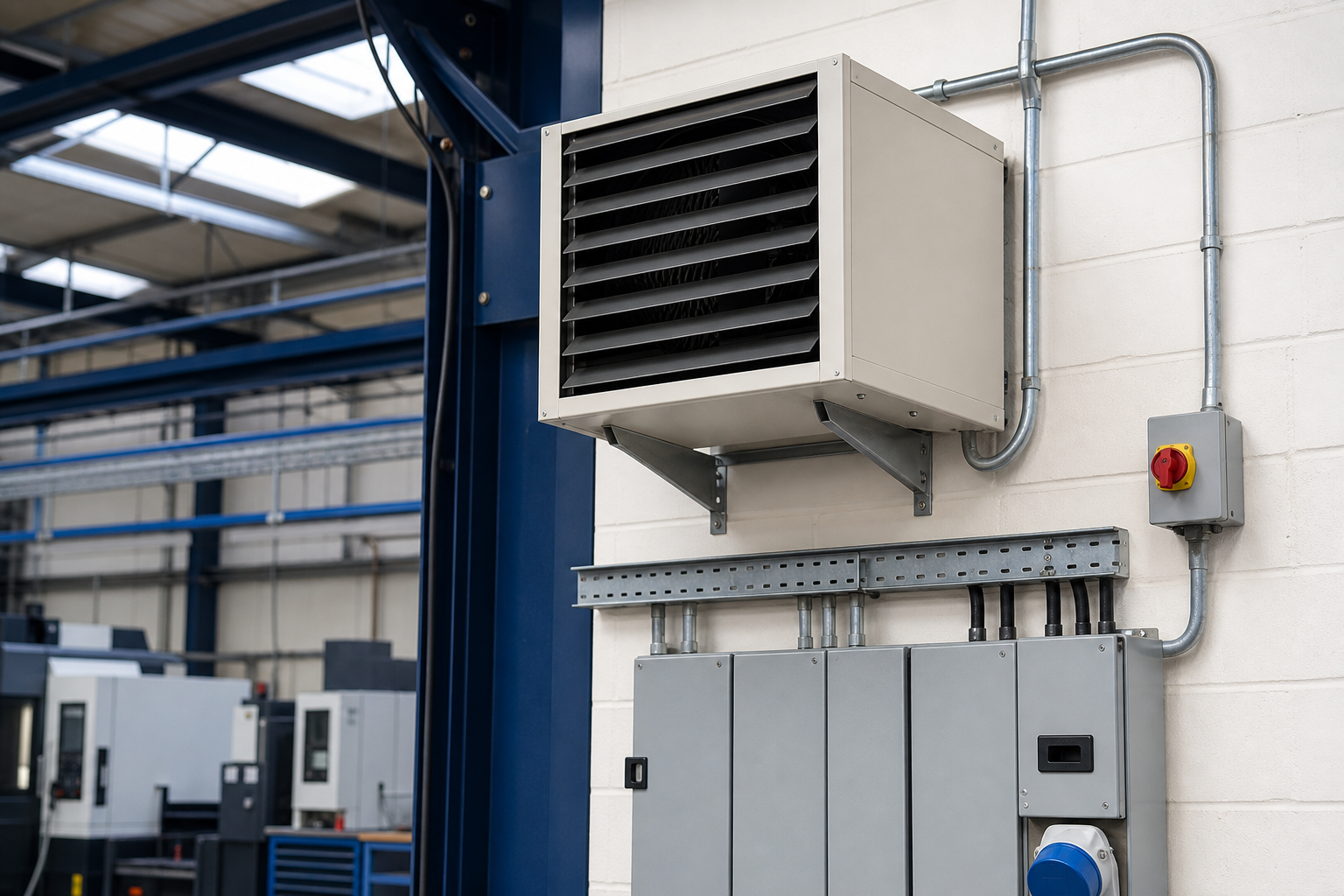
Need help choosing between gas and electric?
Send Factory Heaters the building’s length, width, ceiling height, insulation condition, door usage, available gas and electrical supplies, required temperature and operating hours. The team can help identify suitable products and outputs.
Where the project requires a site survey, detailed system design or installation, speak to Winrow about industrial heating installation.
FAQs
Are electric warm air heaters cheaper to install than gas heaters?
They can be where sufficient electrical capacity already exists and avoiding a flue reduces the work required. If the electrical supply or distribution board needs upgrading, electric installation may become substantially more involved.
Is gas or electric heating cheaper for a warehouse?
Gas often has a lower energy cost for large, frequently heated spaces, but the answer depends on the building’s heat loss, heater efficiency, operating hours and contracted tariffs. Compare total annual cost rather than fuel price alone.
Do electric warm air heaters need three-phase power?
Many commercial models do. The Winterwarm EH range uses a 400 V three-phase and neutral supply for most outputs, while some smaller models can support single-phase connection. Confirm the precise requirements from the selected product documentation.
Do gas warm air heaters need a flue?
Indirect-fired commercial gas warm air heaters normally require a correctly designed flue to discharge combustion gases. Flue arrangement and ventilation must be assessed as part of the installation.
What size warm air heater does a warehouse need?
Sizing depends on cubic volume, insulation, air leakage, door openings, required temperature rise and operating pattern. Floor area alone is insufficient. Large or complicated buildings should receive a proper heat-loss assessment.
Can gas and electric warm air heaters be used in the same building?
Yes, where the design supports different zones or requirements. A mixed system should be planned carefully so controls, electrical demand, air distribution and safety requirements work together.
Share.
Shop Our Industrial Heating Solutions

Latest.