Tankless vs Storage Water Heaters: UK Business Guide
Tankless vs Storage Water Heaters: Which Is Right for Your Business?
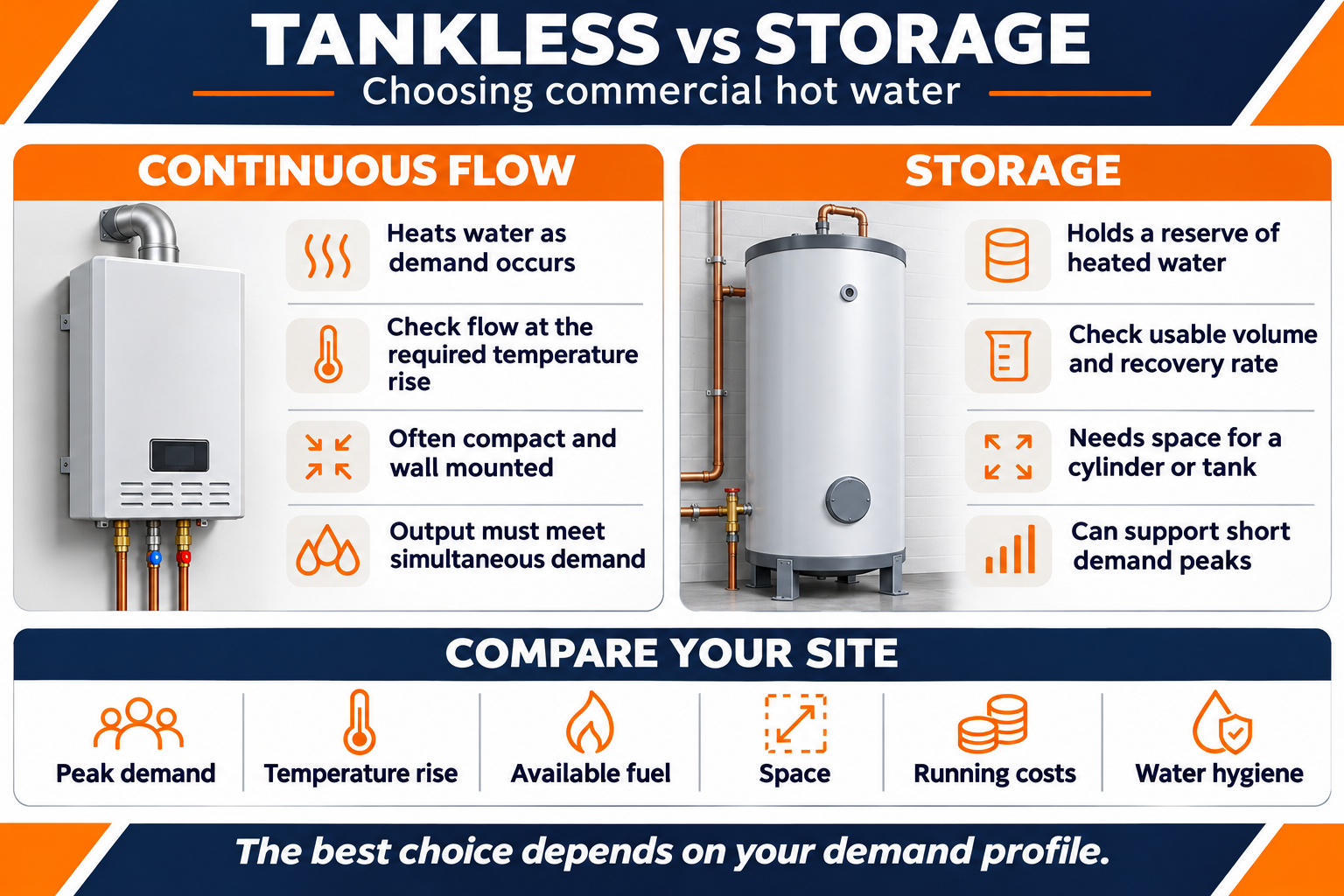
A tankless water heater heats water as demand occurs. A storage system holds a reserve of heated water ready for use. For a business, the better choice depends on how much hot water is needed at once, how long that demand lasts and how quickly the system must recover afterwards.
Continuous flow can suit premises that need hot water over extended periods without a large storage vessel. Storage can help meet short, heavy demand peaks using a reserve accumulated beforehand. Neither is automatically cheaper or more efficient in every building.
Before choosing, compare the complete installation: heat source, peak demand, temperature rise, available space, water supply and maintenance requirements.
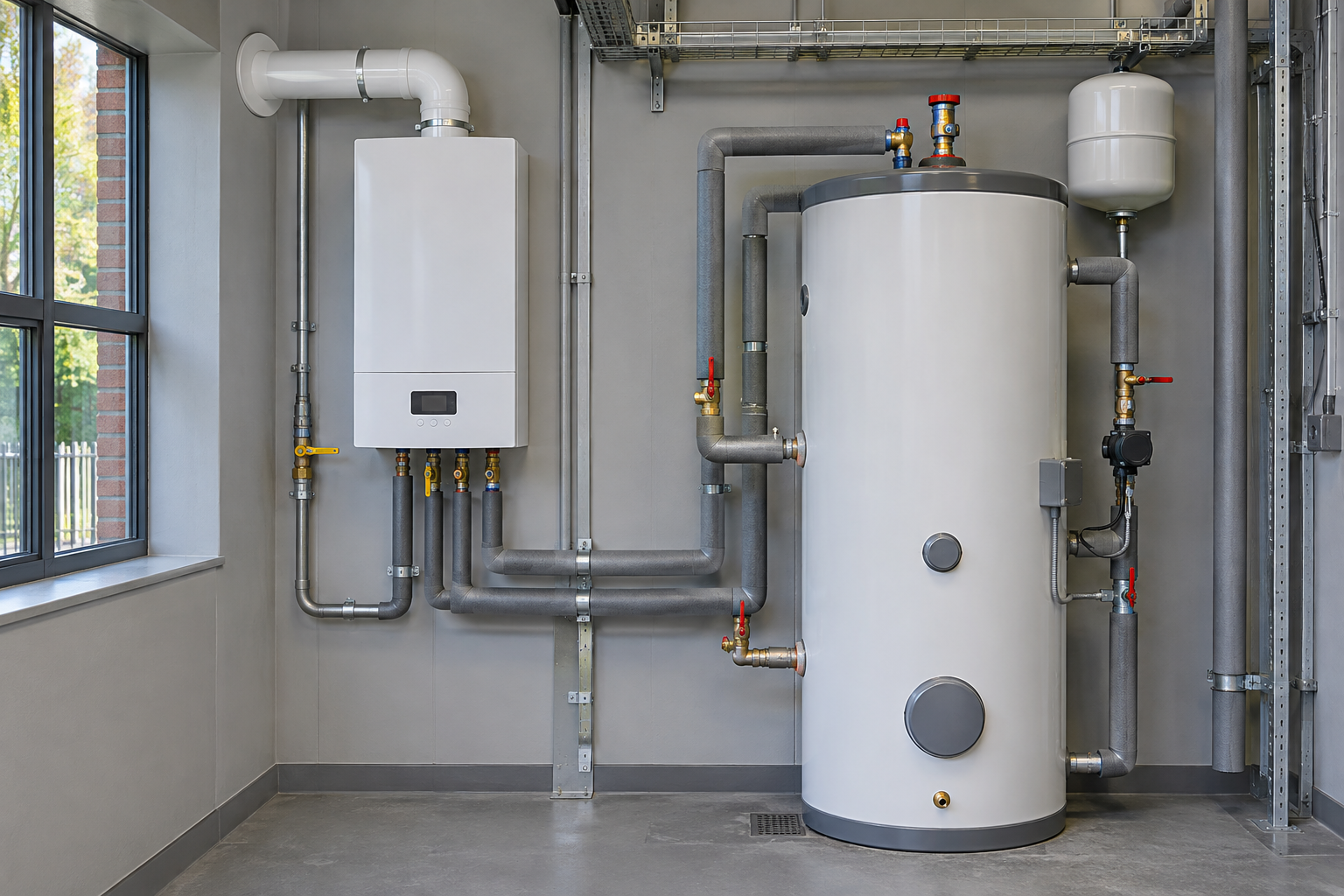
Tankless water heater vs tank: the main differences
Buying consideration | Tankless / continuous flow | Storage
How it provides hot water | Heats flowing water when required | Supplies water from a heated reserve |
Main sizing question | Can output meet simultaneous flow at the required temperature rise? | Can usable storage and recovery meet the demand profile? |
Sustained demand | Can continue within rated output and supply limits | Depends on reserve plus heat added during use |
Short demand peaks | Requires sufficient installed heating capacity | A suitable reserve can support a brief peak |
Space | Individual units are often compact; access and connections still need space | Requires space for the vessel and associated equipment |
Heat losses | No large stored reserve in a purely instantaneous arrangement; pipework losses remain | Stored water loses heat through the vessel; insulation reduces this |
Water hygiene | Whole-system risk management still required | Whole-system risk management still required |
Installation cost | Depends on output, fuel, flue, water supply and controls | Depends on vessel, heat source, connections and controls |
Tankless and storage describe how hot water is delivered. They do not identify the fuel. A comparison between a gas continuous flow unit and electric storage changes two things at once: the delivery method and the energy source.
How continuous flow water heaters work
When sufficient water flows through the appliance, it heats that water towards the selected outlet temperature. Gas models transfer heat through a heat exchanger; electric instantaneous models use electrical heating elements.
A commercial installation may use one unit or several linked units. Multiple appliances can increase available output and allow staged operation, subject to the system's controls and design.
Continuous flow does not mean unlimited hot water at any flow rate. The appliance has a maximum heating capacity. Incoming water conditions, required temperature, fuel supply and water pressure all affect the result.
Nor does “instantaneous” guarantee hot water immediately at a distant tap. Water already in the pipe between heater and outlet must be displaced unless an appropriately designed circulation arrangement is provided.
Our existing tankless gas water heater guide introduces the equipment for businesses considering a change from stored hot water.
How storage water heaters work
A storage system heats water in a vessel before it is needed. That water may be heated directly or through a heat exchanger supplied by another heat source.
During a demand peak, the system draws on the hot reserve while the heat source replenishes it. Once the useful reserve has fallen sufficiently, performance depends on the recovery rate: how quickly incoming cold water can be heated again.
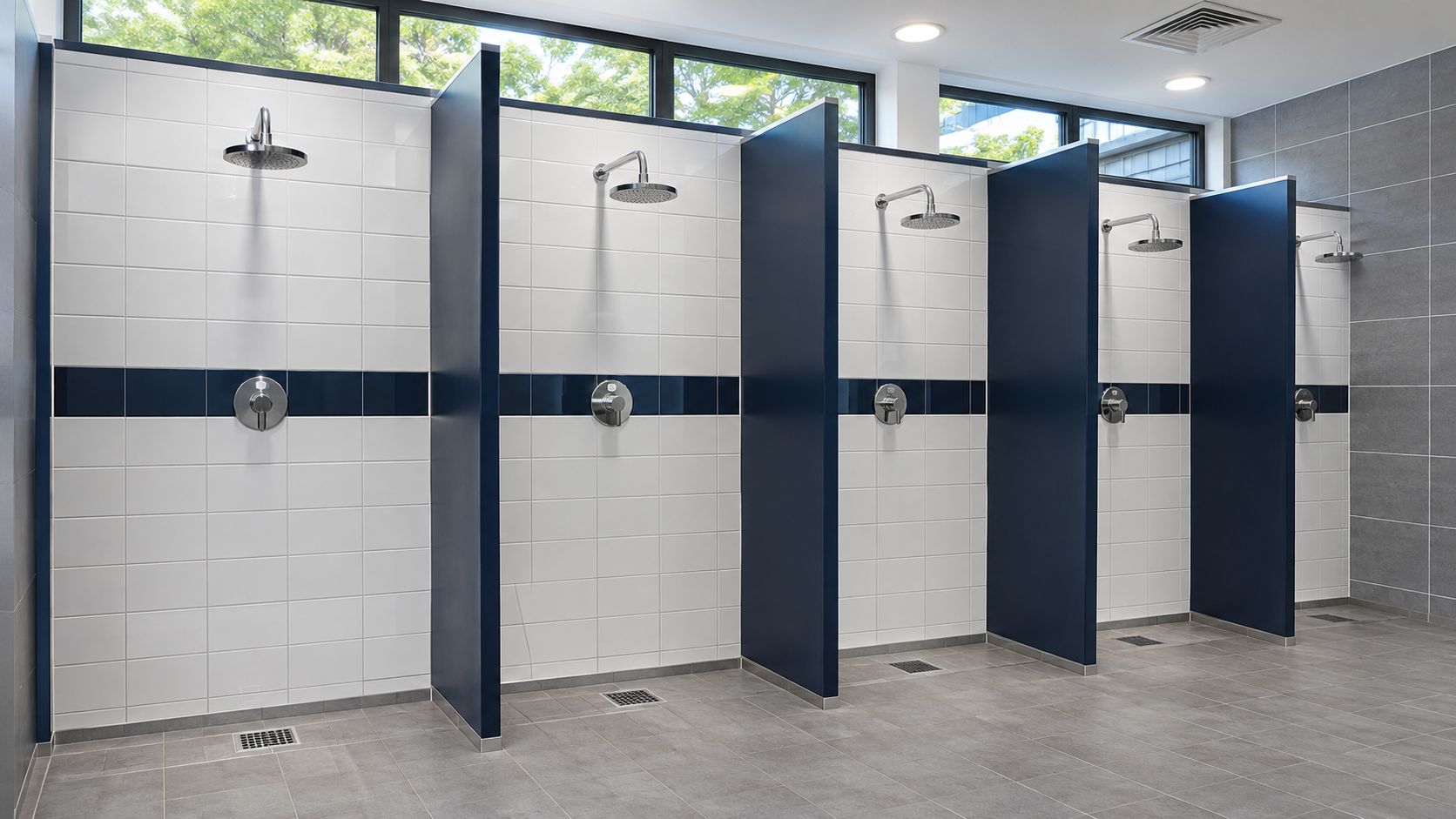
This can be useful where demand is concentrated into short periods, such as showers after a sports session. However, a large cylinder is not proof that the building will have enough hot water. Usable volume, storage temperature, mixed outlet temperature, recovery and the time between peaks all matter.
Start with demand, not the number of taps
An outlet count is a starting point, not a specification. Ten taps used occasionally create a different load from ten showers running together.
Record the busiest realistic period:
- Which outlets operate simultaneously?
- What flow does each outlet require?
- What temperature is needed at each use?
- How long does the peak last?
- How soon does the next peak arrive?
- Do washing machines or other appliances fill in batches?
- Will demand grow as the business expands?
For example, five showers each delivering an assumed 8 litres per minute create 40 litres per minute of mixed-water demand while they run together. This is an illustrative demand calculation, not the required heater flow: a designer must account for hot and cold mixing, incoming temperature and the chosen system arrangement.
Daily consumption alone can hide this peak. Two businesses using the same total litres may need very different equipment.
Why temperature rise changes a tankless heater's flow rate
Temperature rise is the difference between the incoming cold water and the required hot-water temperature. Heating water from 10°C to 60°C requires a 50°C rise. Colder incoming water requires more heat to achieve the same outlet temperature.
For a given heating output, achievable flow falls as the required rise increases. That is why a headline litres-per-minute figure should always be checked against its stated test conditions.
Rinnai's commercial technical FAQs explain temperature rise. Its N-Series product information specifies commercial output at a defined rise, illustrating how buyers should compare models.
Ask for performance at your design conditions, including the colder incoming water expected in winter. Do not select a commercial unit solely from the flow figure in its name or shop listing.
When continuous flow is worth considering
Continuous flow deserves consideration where the business needs sustained hot water, available plant-room space is limited or demand varies substantially through the day.
It can also suit a modular approach using several heaters. That arrangement still needs enough water and fuel capacity, appropriate controls and a considered resilience strategy. Multiple units do not automatically guarantee uninterrupted service.
Factory Heaters supplies a range of commercial water heaters, including continuous flow options. Match the proposed appliance to the demand profile before comparing purchase prices.
When storage may be more appropriate
Storage may be attractive where short peaks exceed the output it would be practical to install instantaneously, provided there is enough time and heating capacity to replenish the reserve.
It may also be part of a heat-pump or other system whose operating characteristics benefit from storage. An existing serviceable vessel can influence replacement economics too, although its condition and suitability need assessment.
Avoid assuming that removing a tank always saves money. If the alternative requires extensive gas, electrical or water-supply upgrades, the total project cost may be higher. Equally, retaining an oversized or poorly insulated vessel without reviewing demand can preserve avoidable losses.
Which costs less to run?
Compare systems delivering the same required service. Running costs depend on:
- Useful hot-water demand and temperature rise
- Fuel or electricity tariff
- Appliance performance under actual operating conditions
- Storage and distribution losses
- Recirculation arrangements and pump consumption
- Controls, scheduling and maintenance
A purely instantaneous system avoids maintaining a large hot-water reserve, but pipework and circulation losses can remain. Storage insulation reduces standing losses but does not eliminate them.
Purchase price is only one part of the comparison. Include installation, infrastructure changes, maintenance and expected usage. There is no reliable universal savings percentage for replacing every storage system with continuous flow.
Space and installation: compare the complete arrangement
Wall-mounted units can reduce the floor area occupied by equipment, but service access, flue routes, condensate drainage where applicable and pipework must be allowed for. Gas models also need a suitable gas supply and an appropriate electrical supply for controls and associated equipment.
An external appliance may provide another option where indoor space is restricted. It must be a model approved for external installation, positioned in accordance with its instructions. Weather exposure, frost protection and maintenance access still require attention. See our external commercial Rinnai water heaters for available products.
Storage requires vessel space and provision for maintenance and replacement access. A combined system needs room for both sets of equipment. Assess the complete layout rather than comparing appliance dimensions alone.
Water hygiene applies to both systems
Removing a large storage vessel does not remove every water-hygiene risk. Distribution pipework, infrequently used outlets, circulation and operating temperatures still matter.
HSE explains that hot and cold water systems can present a foreseeable legionella risk and that controls must reflect the system. Read its hot and cold water system guidance when planning changes.
Where temperature is the primary control, HSE sets out storage and distribution temperature guidance. These are system-management conditions, not instructions to deliver unblended hot water directly to vulnerable users. Scalding risk must also be assessed and controlled, including appropriate mixing arrangements where required.
Have the complete system reviewed by a competent person. Choosing a heater is one part of that process.
Can continuous flow and storage work together?
Yes. Some commercial systems combine continuous flow appliances with storage or buffer arrangements to meet a particular demand profile. The correct arrangement depends on peak loads, recovery, circulation, controls and the intended heat source.
This is a system-design decision. It should not be assumed that adding an arbitrary tank to an instantaneous unit improves performance. A well-designed combined arrangement can serve a different purpose from either technology used alone.
What to send before requesting a recommendation
Prepare outlet types, measured or specified flows, simultaneous usage, peak duration, required temperatures, water-supply information, available fuel and electrical capacity, and photographs of the existing plant area.
Include any constraints on flues, external mounting, drainage and access. Existing bills or metered hot-water data can help establish the operating pattern, provided they are interpreted alongside peak use.
Our Rinnai commercial water heater overview provides further product context. For a recommendation, contact Factory Heaters with your building and demand details. Detailed design, installation and water-hygiene management should be arranged with appropriately competent specialists.
Frequently asked questions
Is a tankless water heater better than a tank for a business?
It depends on simultaneous demand, peak duration, temperature rise, supplies and space. Continuous flow can suit sustained demand; storage can support short peaks using an accumulated reserve. Compare systems against the same service requirement.
Can a tankless water heater run out of hot water?
It has no large reserve to empty in a purely instantaneous arrangement, but it has a finite heating output. Demand above its rated capacity at the required temperature rise can exceed what it can deliver.
Does tankless mean hot water reaches the tap instantly?
No. Delivery delay depends partly on the distance and pipe volume between heater and outlet. Circulation arrangements can affect this but need appropriate design and controls.
Can one continuous flow heater supply several showers?
Possibly, depending on shower flows, simultaneous use and temperature rise. Compare the combined design demand with the appliance's rated performance rather than relying on an outlet count alone.
Is storage always more expensive to run?
No. Stored water has standing losses, but total costs also depend on heat source, tariffs, controls, distribution and usage. The lowest-cost choice requires a site-specific comparison.
Does a tankless system remove legionella risk?
No. The entire hot and cold water system still needs appropriate risk assessment and management, including its pipework, outlets and operating conditions.
Share.
Shop Our Industrial Heating Solutions
Latest.